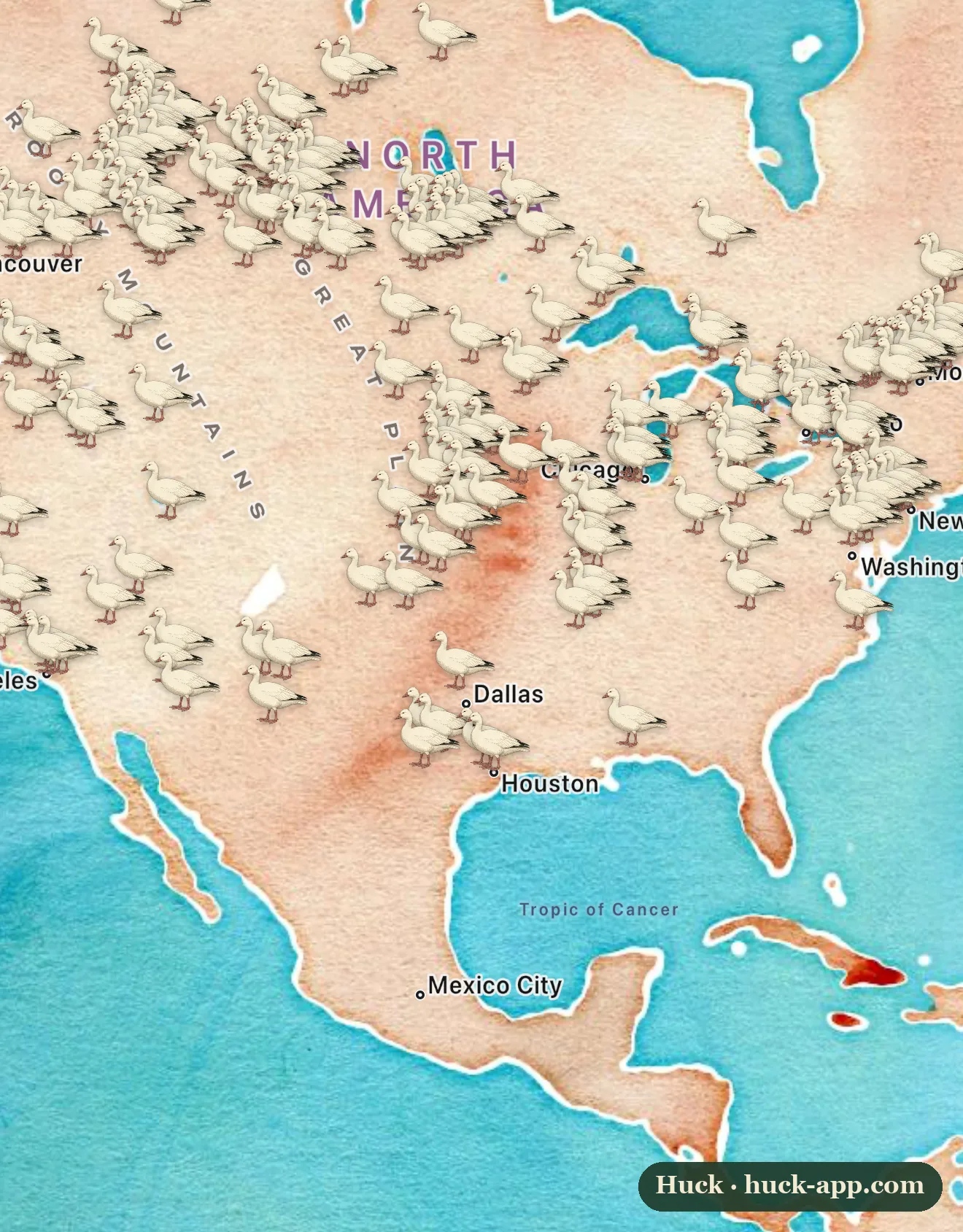
Some birds arrive for the winter one or two at a time. The snow goose arrives like a storm front. Right now flocks that bred above the Arctic Circle are pouring down the middle of the continent, and where they stop they stop in staggering numbers, tens of thousands of white geese packed onto a single refuge marsh. The map shows where those great concentrations come down, a scatter of winter strongholds from the Pacific Northwest to the Gulf to the mid-Atlantic.
The blast-off
The thing you go to see is the lift-off. A field that looks like a snowbank will suddenly erupt, every goose airborne at once, tens of thousands of wings cracking the air in a roar you feel more than hear, the whole mass wheeling and then settling again a few hundred yards away. It happens at dawn as the flocks leave the roost to feed, again at dusk as they pile back in, and without warning in between whenever an eagle or a coyote spooks them. Nothing else in American birding sounds quite like it.
Where to go
A handful of refuges are famous for putting the full spectacle on at close range. Bosque del Apache in New Mexico, on the Rio Grande, is the classic, snow geese and sandhill cranes sharing the same water. Middle Creek in eastern Pennsylvania draws enormous mid-Atlantic flocks and the crowds that follow them. The Sacramento National Wildlife Refuge Complex anchors the Central Valley of California, the Skagit Valley does the same north of Seattle, and Loess Bluffs in northwest Missouri can hold geese by the hundreds of thousands at peak. The Gulf coast of Texas and Louisiana and the Chesapeake country fill in the rest of the winter map.
When to go
The flocks build from November and peak through the dead of winter, roughly December into February, before the push back north begins. Go at first light for the morning fly-out, when the geese lift off the roost against a cold sky, or stay for the evening return. Bring something warm; the best goose mornings are the bitter ones.
Two geese in one, and a goose with a problem
Look closely at a flock and you will notice some birds are not white at all but slate gray with a white head. Those are the blue morph of the same species, once thought to be a separate kind of goose entirely, now known to be the snow goose in a different coat. There is a darker twist to all those numbers, too. Unlike most birds on a winter map, the snow goose is not in trouble; it is almost too successful. Rich farm grain has swollen the population so far that the geese are stripping their own fragile Arctic breeding tundra bare, and wildlife agencies have taken the unusual step of loosening hunting rules to try to bring the flocks back down. A blizzard of geese is a wonderful thing to stand under and a complicated thing to manage.
About the data
This map is built from roughly 33,000 research-grade snow goose observations on iNaturalist, with open coordinates, so the winter strongholds are real and not an artifact of hidden pins. Community sightings follow people as well as birds, but the great refuges still stand out, which is exactly where the flocks, and the photographers, pile up. The breeding grounds lie far off the top of this map, on the Arctic coasts of Canada and beyond.