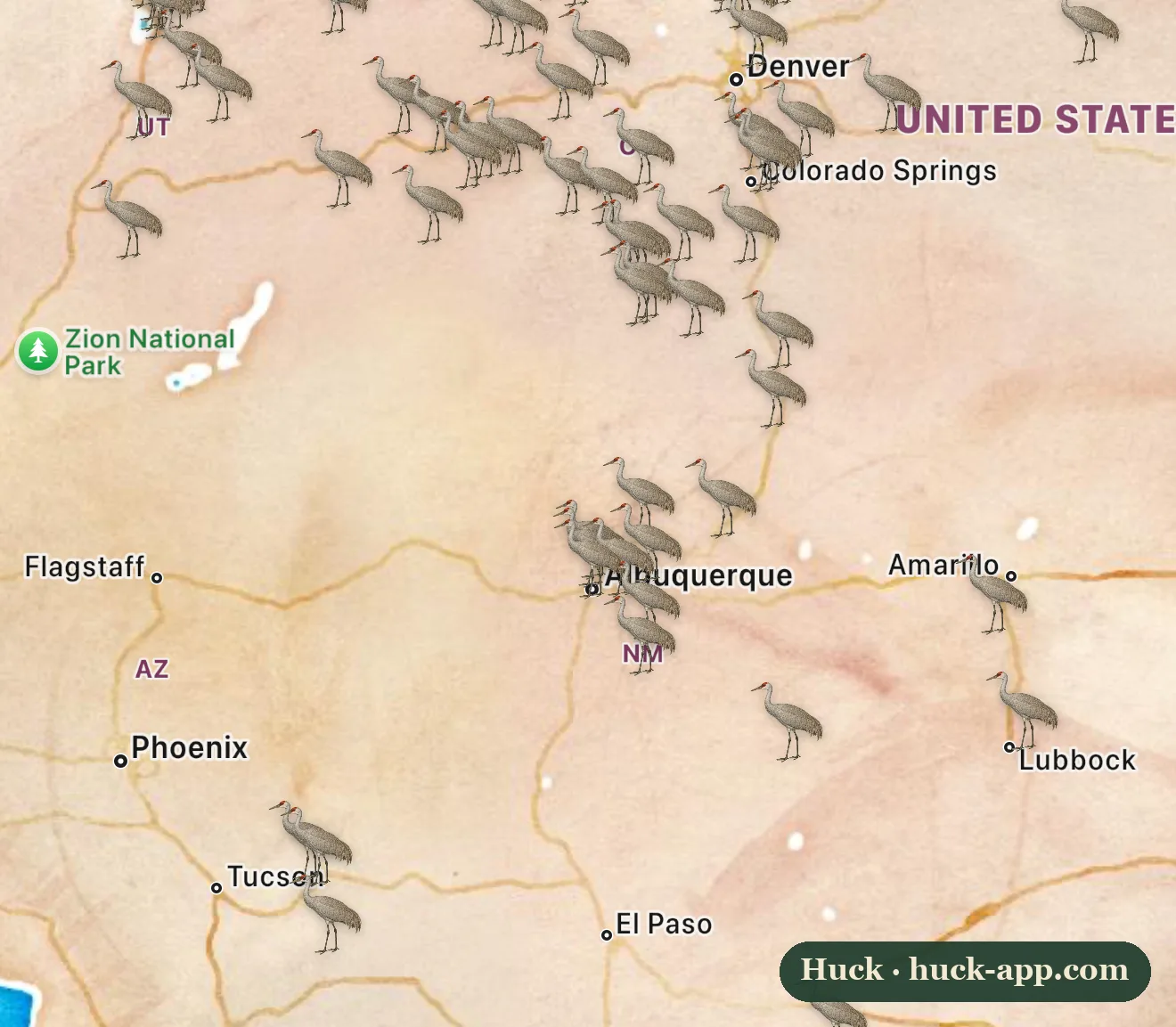
If you stand at the edge of a roost pond at Bosque del Apache before sunrise on a December morning, you hear them before you can see anything at all: a rolling, rattling bugle from thousands of throats at once, building in the dark. Then the light comes up and the sandhill cranes lift off the water in long gray waves, flight after flight, heading out to feed in the fields. This is one of the great winter wildlife shows in North America, and the map shows where the cranes concentrate once they reach the Southwest.
A bird older than almost everything
The sandhill crane is one of the oldest bird species still alive, with fossils going back millions of years, and it carries that antiquity in its voice. The bugle rolls for miles because the windpipe coils like a trombone inside the breastbone, giving the call its strange prehistoric rattle. These are tall birds, four feet or more, that pair for life and dance for the sheer motion of it, leaping and bowing and tossing grass in the air. A field full of cranes at midday is constant, restless movement.
Where the winter flocks gather
The map’s brightest knot sits on the Rio Grande of New Mexico, where Bosque del Apache National Wildlife Refuge manages its ponds and fields expressly for cranes and shares them with tens of thousands of snow geese. Upstream, the valley near Bernardo and La Joya holds more. To the north, Colorado’s San Luis Valley around Monte Vista is the other great southwestern hub, a spring and fall staging ground famous for its own crane festival. Birds scatter on into southern Arizona’s Sulphur Springs Valley near Whitewater Draw and across west Texas. We mapped the whole continental migration separately; this is the southwestern wintering end of it, where the flocks settle in and stay.
When to go
The cranes arrive through the fall and winter in good numbers from about November into February. The show is at the edges of the day: the dawn fly-out from the roost ponds, when flight after flight lifts into the cold, and the evening fly-in as they stream back to the water at sunset. Bosque holds its Festival of the Cranes in November, timed to the arrival, and the refuge loop road puts you right alongside the roosts. Dress for a hard freeze and get there in the dark.
About the data
This map is built from research-grade sandhill crane observations on iNaturalist, mapped in Huck, and counts are current as of October 2026. Most crane records carry open coordinates, so the concentrations on the Rio Grande and in the San Luis Valley are real; a small fraction are obscured, so a few pins are approximate. Because cranes do not breed this far south, essentially every bird on this map is a wintering or migrating crane, which is why the southwestern pattern reads so cleanly.