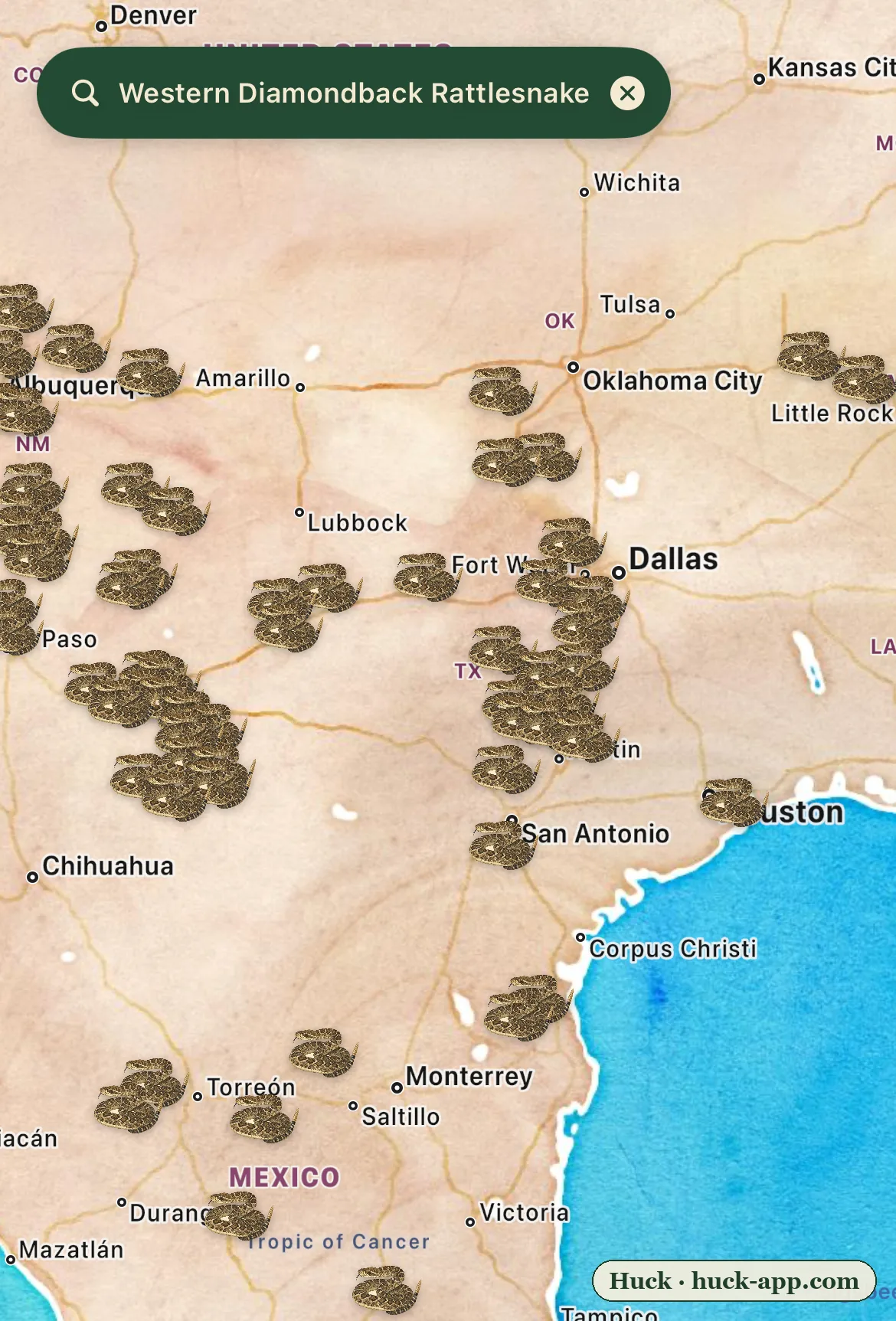
The map above is a picture of abundance. Every mark is a verified western diamondback rattlesnake sighting, and they blanket Texas, densest right across the dry rangeland of the west-central part of the state. That abundance is the whole reason for what happens there every spring. In Sweetwater, Texas, and a handful of other towns, hunters pump gasoline into the snakes’ underground dens to flush them out, haul in thousands of pounds of live rattlesnakes, and butcher them in front of a crowd. It is called a roundup, it has run since the 1950s, and the map is why almost nobody stops to ask whether it should.
What a roundup actually is
The Sweetwater roundup bills itself as the largest in the world, and in a typical year it kills well over a ton of rattlesnakes, sometimes several. The collecting method is the problem. Pouring gasoline into a den to drive snakes out is indiscriminate: the fumes do not distinguish a rattlesnake from the box turtles, other snakes, and invertebrates that shelter in the same burrows, and they can foul the groundwater underneath. Gassing is already illegal in most states for exactly this reason. And a rattlesnake den, a hibernaculum, is not a hiding spot the snake picks fresh each year. Generations return to the same rock crevice. Destroy one and the animals that depended on it are simply gone.
It does not have to look like this. The rattlesnake festivals in Claxton and Whigham, Georgia, dropped the killing years ago and became no-kill wildlife festivals, and they still draw crowds. The spectacle survived without the slaughter. Sweetwater kept the slaughter.
The warning sign is already in the data. Biologists who track the animals brought to roundups have documented the average size of the snakes shrinking over the decades, which is the classic signature of overharvest: take the big ones long enough and only small, young ones are left. An abundant species can be strip-mined faster than the abundance suggests.
The cousin that shows where this ends
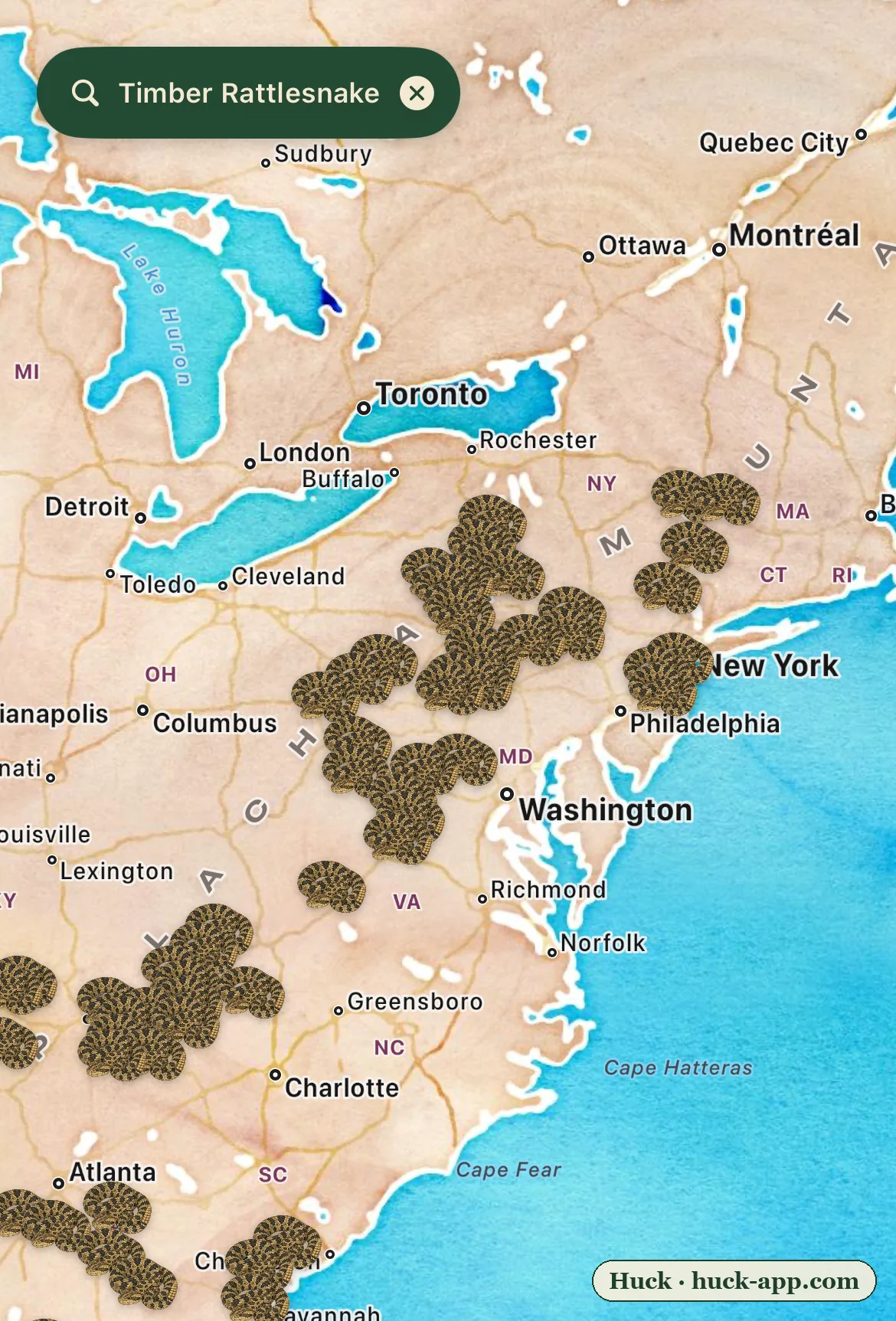
Put the timber rattlesnake on the map and you see the other ending. Same genus, opposite fate. Colonists hunted it with cash bounties for three centuries, and today it is gone entirely from Maine and Rhode Island, listed as endangered or threatened in a dozen states, and legally protected across most of its northern range, where killing one is a crime. On the map it survives only along the rocky Appalachian spine, the terrain too steep and broken for people to have finished the job. Look closely and the pins themselves are approximate, because iNaturalist deliberately blurs this animal’s locations. Collectors still raid its dens.
The reason the timber rattler could not take what the diamondback takes comes down to speed. A female timber rattlesnake does not reproduce until she is roughly seven to eleven years old, and then only every few years. A species that slow cannot replace what a bounty or a roundup removes. The western diamondback breeds faster in a warmer, longer season, and that has hidden the same pressure so far. So far is not forever, which is what the shrinking snakes at Sweetwater are quietly saying.
The case for the animal you were taught to hate
Here is the part that tends to change minds. Rattlesnakes are rodent specialists, and in the Northeast that makes the timber rattlesnake an unlikely ally against Lyme disease. Researchers have estimated that a single timber rattlesnake removes thousands of ticks from the landscape every year, not by eating the ticks but by eating the mice and chipmunks that carry them, on the order of a few thousand ticks per snake per season. Remove the snakes and you keep the rodents, and the disease-carrying ticks they ferry. The animal three centuries of Americans tried hardest to wipe out may be quietly working against the thing those Americans’ descendants fear more.
What the community data shows
These maps are built from research-grade community observations on iNaturalist: about 29,000 western diamondback records, most with open locations, against a smaller and deliberately obscured set for the timber rattlesnake. As always, sightings track where people look as much as where snakes are, and a busy map is not a headcount. The timber rattlesnake’s data looks respectable in part because the people who study it watch it so closely. What the two maps really show is not population, it is relationship: one rattlesnake we still treat as inexhaustible, sprawling in the open, and one we nearly used up, hiding on the ridgelines with its address redacted.
About the data
Sightings shown are research-grade community observations from iNaturalist, mapped in Huck; counts are current as of August 2026. Timber rattlesnake coordinates are obscured by iNaturalist to protect the species from collection, so those pins are approximate. Roundup figures and history draw on reporting and research on the Sweetwater Jaycees roundup and on published studies of rattlesnake roundup harvest trends and timber rattlesnake life history.