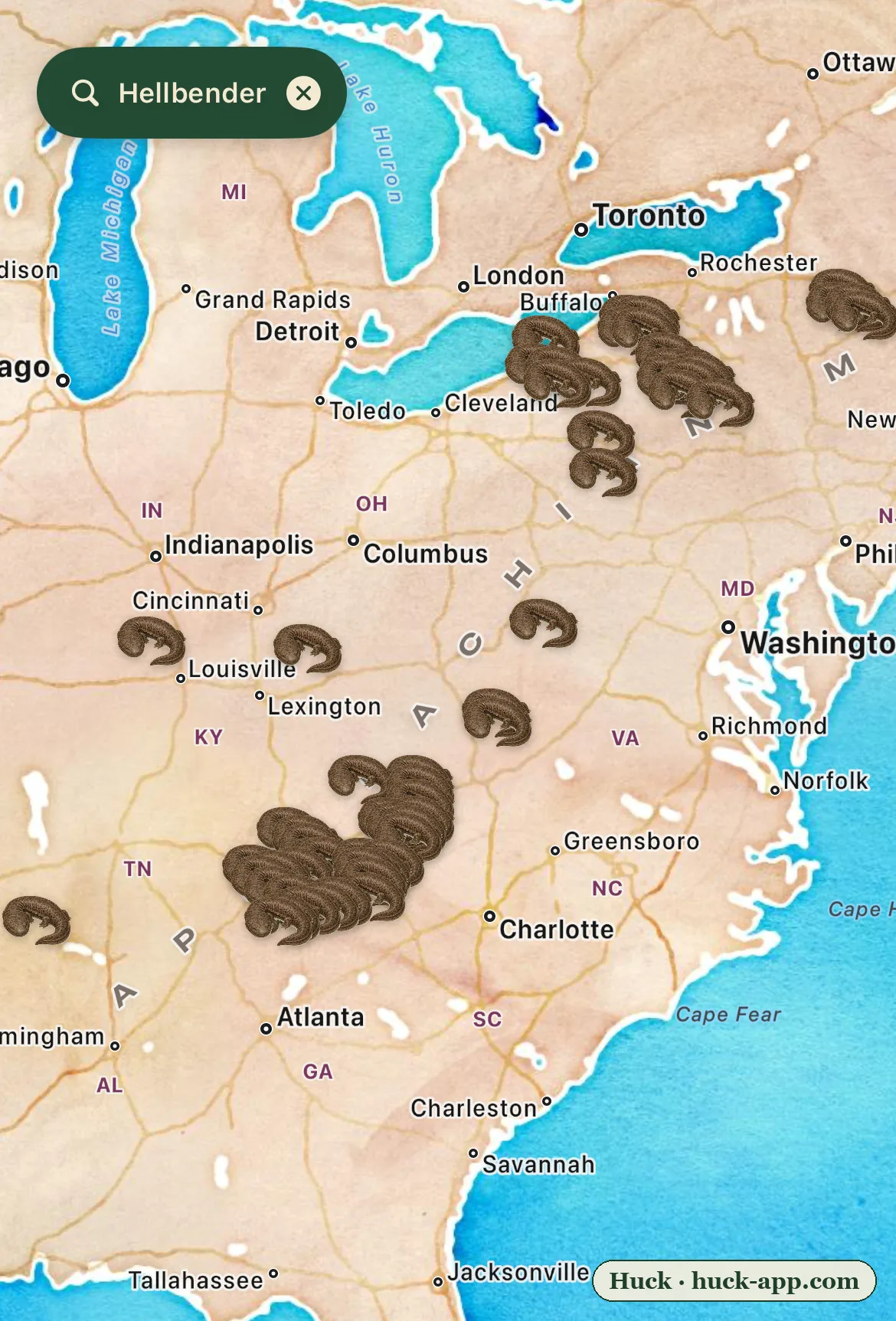
The map above is really a map of clean water. Every mark is a place people have found a hellbender, and the pattern is not random: a dense knot in the southern Appalachians, a band across the Allegheny, scattered pockets down the Ohio and Tennessee drainages, and almost nothing in the lowlands between. That is because this animal cannot live just anywhere. It needs cold, fast, clear, oxygen-rich streams, and where the water fails that test, it is gone. The hellbender is not only wildlife. It is a water-quality reading you can hold in two hands.
Meet the snot otter
The eastern hellbender is the largest salamander in North America, reaching well over two feet, living thirty years or more, and spending nearly all of it under a single flat rock in a mountain stream. The folk names are a mix of disgust and affection: snot otter, lasagna lizard for the ruffled skin, Allegheny alligator, devil dog, mud devil. None of them are earned by its behavior, which is shy and harmless. It eats mostly crayfish. For two centuries anglers killed it on sight anyway, convinced it was venomous or that it devoured trout and their eggs. It is neither venomous nor much interested in fish. The reputation was pure superstition, and the animal paid for it.
Why it works like a gauge
The hellbender breathes almost entirely through its skin. Those famous wrinkled folds are surface area, the way a radiator has fins, and they only pull enough oxygen when the water is cold and moving fast. Silt is lethal to it: sediment smothers the clean gravel where the male guards the eggs and clogs the spaces under the rocks where the animals live. So a hellbender behaves like a needle on a dial. Where a stream stays clean, it hangs on for decades. Where mining, development, or farm runoff fills the water with sediment, it is among the first things to vanish. A creek that still holds hellbenders is a creek with genuinely good water, and most creeks no longer qualify.
The animal that tells you your water is clean is running out of clean water to live in.
The count, and the limbo
When the US Fish and Wildlife Service reviewed the eastern hellbender, it counted 626 known historical populations and found only 371 still hanging on, with just 12 percent of them successfully reproducing. In December 2024 the Service proposed listing it as endangered. The deadline to finalize that decision came and went in December 2025, and it is now parked as a long-term action with no date, while Defenders of Wildlife and the Center for Biological Diversity press for protection and a 2026 lawsuit tries to force a timeline. The threats are not mysterious: sediment from coal mining and development, dams that warm and choke the streams, and poaching for the exotic pet trade.
Why this map is thin, and hidden
You may notice the map is sparse, and that the pins are approximate. Both are part of the story. A hellbender was never as easy to find as a deer or a hawk, hidden as it is under rocks in fast water, and iNaturalist deliberately blurs its locations because collectors still poach it. So what you are looking at is a rare animal, protected by being hard to pin down, clinging to the few streams still clean enough to hold it. The blank spaces are not all places nobody looked. Many are places the hellbender used to be.
The case for the ugly one
It is easy to root for an eagle. The hellbender asks something harder. It is slimy, prehistoric, and named after mucus, and for generations people killed it over a fear that was simply false. But it may be the most useful amphibian in Appalachia: a free, living water monitor sitting in the same creek where kids swim and towns draw their drinking water. Protecting it is not sentiment. It is protecting the water it is standing in, which is also yours.
About the data
Sightings shown are research-grade community observations from iNaturalist, mapped in Huck; counts are current as of August 2026. Hellbender coordinates are obscured by iNaturalist to protect the species from collection, so those pins are approximate, and community sightings reflect where people look, not a population census. Population and status figures come from the US Fish and Wildlife Service’s December 2024 proposed listing rule for the eastern hellbender.