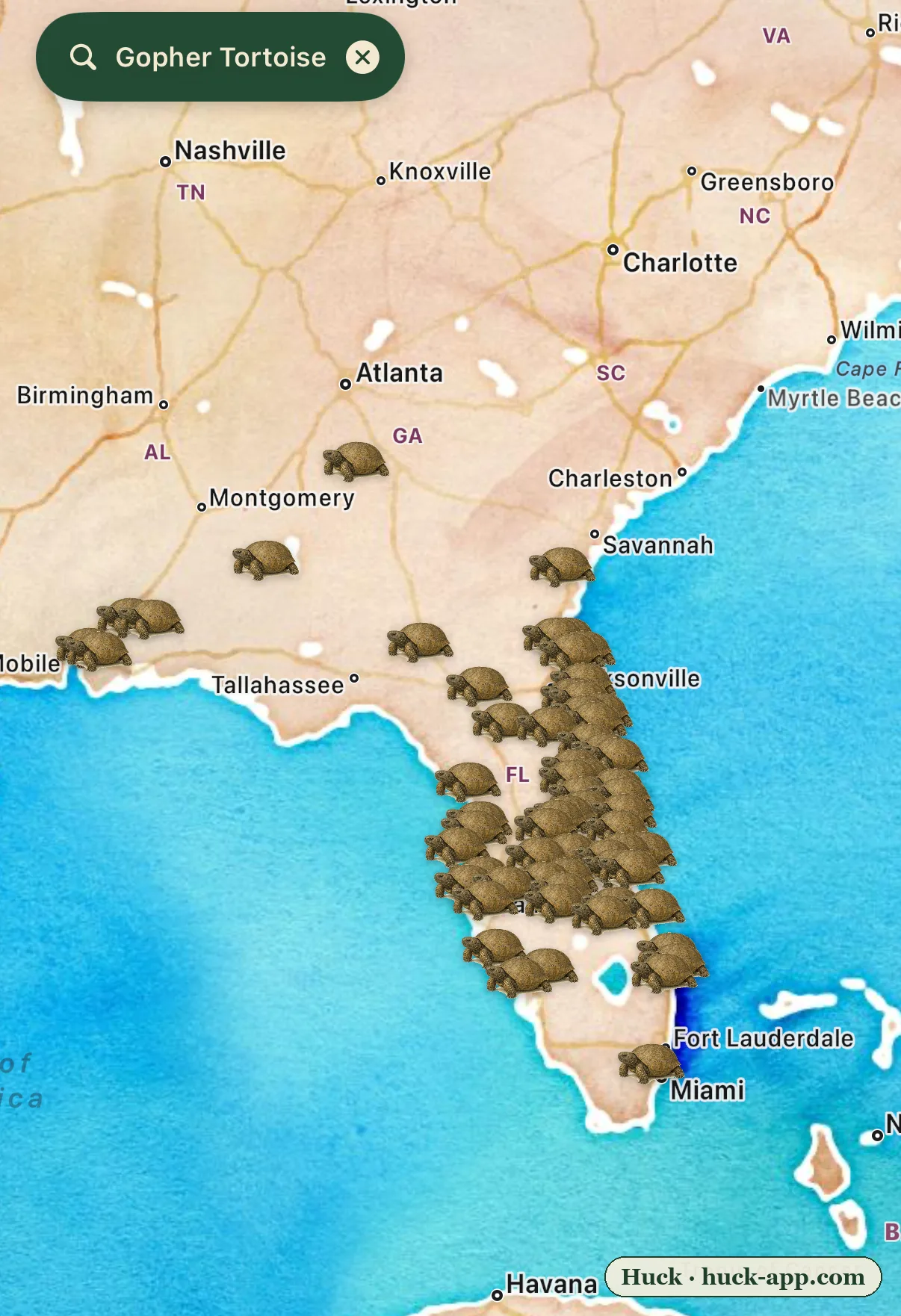
Meet the most important animal in the Southeastern scrub, and one of the least noticed. The gopher tortoise spends its life digging. A single tortoise, slowly, over years, excavates burrows up to 40 feet long and 10 feet deep, and it will use dozens of them across its territory. The map above shows where it still does, densest across Florida and pushing up into Georgia, coastal Carolina, and the Gulf Coast. Those burrows are the reason a slow, quiet reptile matters far more than it looks like it should.
The landlord of the sandhills
A gopher tortoise burrow is not just a hole for a tortoise. It is an underground apartment building. More than 350 other species use these burrows: the gopher frog, the threatened eastern indigo snake, burrowing owls, rabbits, foxes, rattlesnakes, and a long list of insects all shelter inside them from heat, cold, drought, and the wildfires this ecosystem depends on. Biologists call the tortoise a keystone species, which is a technical way of saying that when it goes, a whole community goes with it. Remove one tortoise and you do not lose one animal. You collapse a building full of tenants.
Buried alive, then billed for
The gopher tortoise needs exactly the dry, sandy, well-drained uplands that Florida developers want, and that overlap has gone badly for the tortoise. For years the state issued permits that let builders seal the tortoises in their burrows and pave over them, burying them alive. That practice, entombment, was legal in Florida until 2007. It was replaced by relocation permits, where a developer pays to have the animals dug up and moved elsewhere. That is better, but not painless: relocation is stressful, survival is not guaranteed, and it does nothing for the 350 species that were living in the burrow that just became a parking lot.
The protection that mostly is not there
Given all that, you might assume the gopher tortoise is federally protected. Across most of its range, it is not. The western population, west of Alabama’s Mobile and Tombigbee rivers into Mississippi and Louisiana, has been federally threatened since 1987. But in 2022, after a long review, the US Fish and Wildlife Service ruled that the far larger eastern population, all of Florida, Georgia, South Carolina, and eastern Alabama, did not warrant listing, judging that existing state measures were enough. Conservation groups disagreed sharply. So the tortoise across nearly this entire map, including almost all of Florida, has no federal safety net, even as the uplands it depends on keep turning into subdivisions.
What the community data shows
This map is built from roughly 40,000 research-grade gopher tortoise observations on iNaturalist, dense in Florida and thinning north and west. The coordinates are obscured to protect the animal, since gopher tortoises are still collected illegally, so the pins are approximate. Sightings also track people: Florida’s density partly reflects how many Floridians photograph a tortoise ambling across a yard or a golf course. But the overall shape is real. This is a Coastal Plain specialist with nowhere else to go, and its map is steadily being redrawn by ours.
Why it is worth the trouble
A gopher tortoise can live 60 years, sometimes 80, longer than the mortgage on a house built where its burrow used to be. It is slow, ancient, and quietly load-bearing for an entire ecosystem, the rare animal that builds the shelter everything else borrows. Protecting it was never really about one reptile. It is about keeping the roof on 350 other species at once, and right now, across most of its range, no one is required to.
About the data
Sightings shown are research-grade community observations from iNaturalist, mapped in Huck; counts are current as of August 2026. Gopher tortoise coordinates are obscured by iNaturalist to protect the species from collection, so those pins are approximate. Listing history and the 2022 finding come from US Fish and Wildlife Service records, and the burrow-commensal figure reflects long-standing research on the species as an ecosystem engineer.